Assises du Fleuve: 41 Vessels Measured to Prove the Carbon Case


Thursday 15 October. The Assises nationales du fleuve, France's national inland waterways convention, opens its third edition in Marseille for two days hosted by Entreprises fluviales de France (E2F), the French inland shipping federation. The choice of city is deliberate: Marseille is the maritime gateway of the Mediterranean-Rhône-Saône corridor, France's second inland freight axis behind Seine-Escaut.
The backdrop invited itself. After a summer of heatwaves and low water levels, water resource management takes up a full session of the programme. Yet behind the expected calls for a French "new deal" on inland waterways ahead of the 2027 election lies a more prosaic difficulty: inland shipping struggles to prove with figures what everyone grants it in principle.
Assises nationales du fleuve 2026: the practical details
What. The third edition of the Assises nationales du fleuve, organised by Entreprises fluviales de France (E2F).
When. Thursday 15 October 2026, 8.00 a.m. to 5.30 p.m., and Friday 16 October 2026, 8.00 a.m. to 2.30 p.m.
Where. City Center Vieux-Port, 2 rue Henri Barbusse, 13001 Marseille, France.
Getting there. About fifteen minutes on foot from Marseille-Saint-Charles station, and twenty-five minutes by car from Marseille-Provence airport.
Programme. A session on managing and protecting water resources, the Living with Rivers international awards presented by the Initiatives for the Future of Great Rivers association, and a strand on the role of inland waterways in logistics, transport and economic development.
Speakers. Around sixty speakers are announced, among them Erik Orsenna, Cécile Avezard of Voies navigables de France and Laurence Borie-Bancel of Compagnie nationale du Rhône, together with several executives of the Port of Marseille Fos, including Christophe Castaner, Hervé Martel, Sarah Amri and Amal Louis.
Organisation. Editorial direction by Didier Leandri (E2F) and François Remoué (GO-BETWEEN Conseil), production by Ilago.
Information and registration. On the official event website, or by telephone on +33 6 51 52 14 58.
The paradox inland shipping has carried for years
Waterborne freight is universally presented as more frugal than road haulage. That superiority, however, still rests largely on average emission factors and theoretical ratios rather than on measurements taken on board, vessel by vessel and voyage by voyage. A shipper weighing a lorry against a barge does not decide on a national average: what is needed is defensible data, ideally verifiable by a third party.
The difficulty is well known within the sector. French inland fleets include a share of older units, often operated by very small firms and rarely instrumented. The absence of data reflects a lack of equipment rather than a lack of interest. It is precisely that bottleneck the LOG-te scheme sets out to clear.
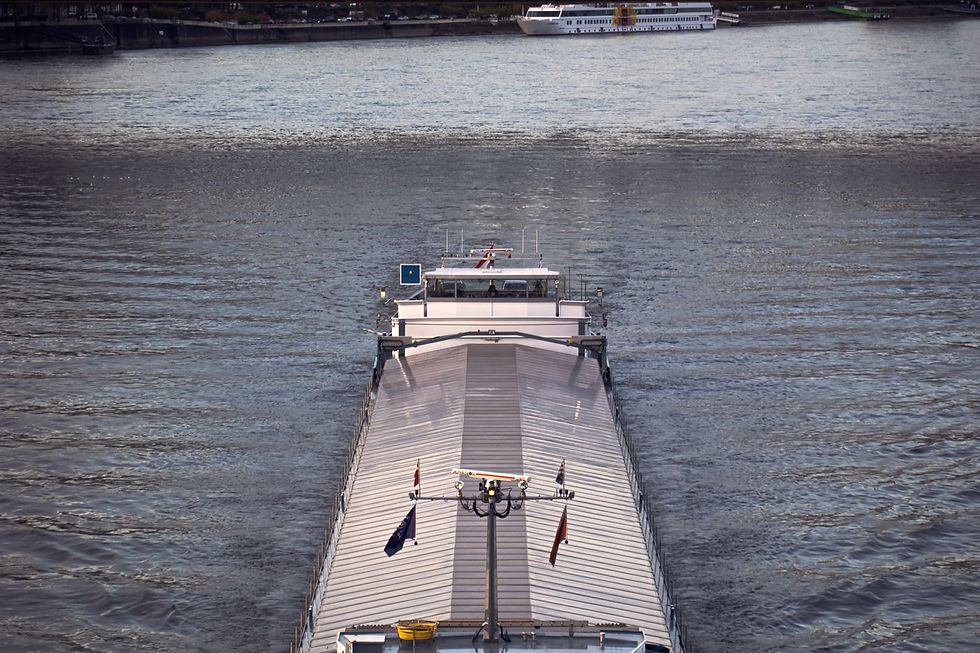
41 vessels instrumented under the ReMoVe programme
The announcement. ADEME, E2F and the Paris Port Community (CPP) have selected BoatOn to equip 41 inland vessels with real-time carbon impact monitoring.
The framework. The LOG-te scheme sits within ReMoVe, a French energy savings certificate programme worth 38 million euros over four years.
The package. Each vessel receives a connected box and one year of access to the BoatOn Book; six older units will be fitted with flow meters by Ecomer Data.
The stake. Producing, for the first time across a representative fleet, real consumption and emissions data.
The operation falls under LOG-te, led by ADEME, whose purpose is to cut energy consumption and CO2 emissions in transport and logistics by encouraging modal shift. For each vessel, the programme funds the supply and installation of a connected box that automatically collects consumption and navigation data, together with a year of access to the BoatOn Book, which brings together maintenance management, crew management, the logbook and automated carbon reporting. Six older units, until now uninstrumented, will additionally receive flow meters installed by Ecomer Data and interconnected with the software so that measurements can be centralised and analysed.
The division of roles within the consortium is worth noting, since it explains the scheme's ability to reach operators on the ground: E2F handles national coordination with the public authorities, while the Paris Port Community, with its 130 members along the Seine, drives territorial rollout and the mobilisation of owners.
This ReMoVe project shows that decarbonising inland shipping is possible today, on existing vessels and at scale. We are proud to put our technology at the service of operators on France's navigable waterways. — Bertrand Gerbaud, President of BoatOn
Why the existing fleet is the real reservoir
Most decarbonisation policy concentrates on fleet renewal and alternative propulsion. Those programmes are necessary, but they unfold over decades, whereas the vessels trading today will keep trading for a long time. BoatOn advances a view of its own on this point, and it should be read as such: vessels in service would account for more than 80 per cent of the sector's emissions, which would make optimising operations and maintenance an immediate lever.
The argument holds all the better because the gains available without heavy capital expenditure are seldom spectacular taken singly, yet they accumulate: engine tuning and monitoring, hull cleanliness, handling, voyage planning, detection of consumption drift. They still have to be visible. That is the value of continuous measurement over a one-off audit, a mechanism we observed in the operational data of wind-assisted ships.

A tightening regulatory calendar
The project lands at a moment when documentary pressure is rising across professional fleets. The voluntary commitment charters under LOG-te, which include an initial diagnostic followed by an action plan, prefigure what regulation will progressively impose. On the maritime side, the European Commission proposed in July extending the European carbon market to ships of 400 to 5,000 GT by 2031, after a mandatory reporting phase.
The logic is the same everywhere, and it serves as a warning to inland operators: you begin by reporting, then you pay on what you have reported. An operator who already holds a reliable consumption history approaches that sequence with a defensible baseline; one starting from nothing simply endures it.
What the scheme changes on board
For the operators selected, the shift comes down to a handful of very practical points:
Automatic collection of consumption and navigation data, replacing manual entry and reconstruction from bunker invoices.
Measurement made possible on older units, through the flow meters fitted to the six uninstrumented vessels.
A single tool bringing together maintenance, crew, logbook and carbon reporting, rather than a patchwork of spreadsheets.
A defensible history, built up as operations proceed and available to a shipper, a lender or a verifier.
A fleet-wide view, allowing vessels to be compared and abnormal variances identified.
That is the purpose of the BoatOn Book, deployed today across passenger transport, inland and maritime freight, fishing and marine works fleets, with the backing of Bpifrance and the French Ministry of the Sea. The principles set out in our guide to marine CMMS apply to inland shipping too, with one difference: the binding constraint there is less port state control than the commercial case made to the shipper.
The Marseille convention will talk at length about corridors, funding and water resources, and rightly so. But shifting freight from lorry to river will not be won on infrastructure plans alone. It will also be won on the sector's ability to produce, at last, the hard evidence for what it has been claiming for twenty years. Instrumenting 41 vessels will not settle the question by itself. It is nonetheless the first time a representative fleet will be measured for real.
Photo credits: Pexels, free licence.